
Quinn Labs · Research Project
LINGUA
Not to replace English. To reconnect people with history.
Can ancient languages become living languages again?
The real problem
This is not really about Latin. It is about access. Roman inscriptions, medieval manuscripts, scientific names, botany, medicine, law, church history and art history are all written in languages fewer and fewer people can read. When the language goes, the door closes.
Roman inscriptions
Names, jobs, ages and grief carved by ordinary people.
Medieval manuscripts
Most of Europe's written record before print.
Scientific names
Every species you can name is a Latin or Greek sentence.
Botany
Plant names describe habitat, leaf, colour and use.
Medicine
Anatomy and diagnosis still run on the vocabulary.
Law
Terms of art that have never been translated out.
Church history
A thousand years of records in one working language.
Art history
Inscriptions, dedications, patrons and iconography.
Prototype concept · the inscription reader
You point your phone at a stone in Chester. It reads back.
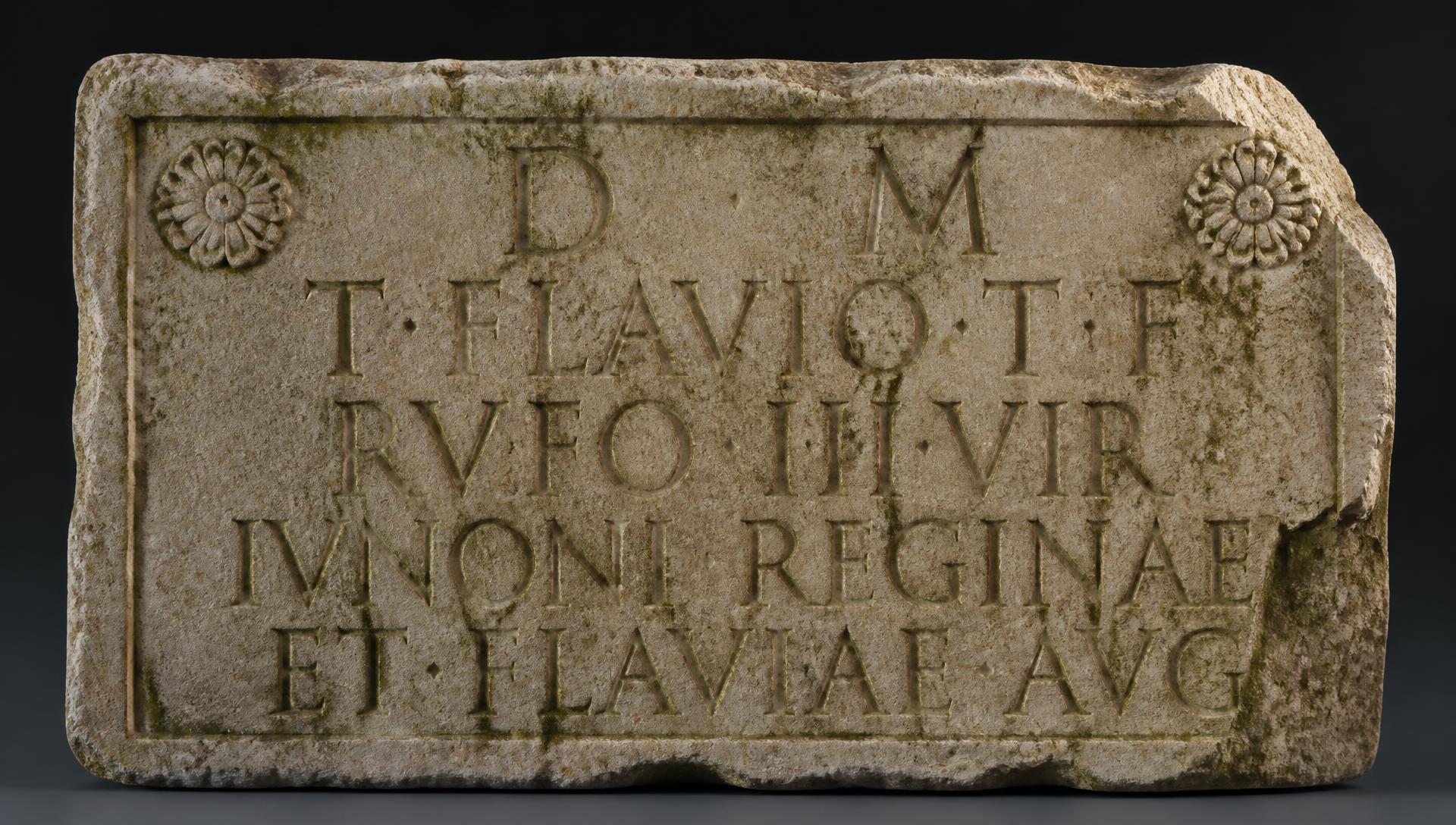
Chester (Deva Victrix) · A funerary altar of the kind found across Roman Britain
Expanded
DIS MANIBUS
To the spirits of the departed.
Stones like this are not monuments to famous people. They are receipts of grief left by families, soldiers, freedmen and heirs. Abbreviations are used because carving is expensive and everyone reading already knew the formulae — the same way we read a road sign without spelling it out.
A composite example built from standard inscription formulae, used to show how the reader would work. Not a transcription of one specific stone.
Where it would live
Point your phone at a stone
It reads the Latin, expands the abbreviations, translates it, explains the grammar, shows how it would have been pronounced, then tells you why the Romans wrote it that way.
In a museum
Instead of a tiny plaque nobody finishes reading, the object explains itself — in its own language first, then yours.
Inside Through Time
Walk through Roman Chester and people greet you. Salve. You pick the language up the way you pick it up abroad, by needing it.
For children
Roman Boy
A comic for children. Nobody notices they are learning Latin, because the language is the smallest part of the page.
Every issue
Five Latin words
Used in the story, never in a vocabulary box.
Every issue
One Roman invention
Drawn in cutaway so the mechanism is obvious.
Every issue
One archaeological discovery
A real find, and how it was interpreted.
Every issue
One historical mystery
Something genuinely unresolved, left unresolved.
Every issue
One recipe
Cookable today, with the ancient version alongside.
Every issue
One garden plant
What it was used for, and whether it still grows here.
Not Latin. Languages.
Latin
Inscriptions, manuscripts, science, medicine, law.
First languageAncient Greek
Philosophy, medicine, mathematics, the New Testament.
PlannedOld English
The layer of English most speakers cannot read.
PlannedOld Norse
Sagas, runes, place names across northern Britain.
PlannedAnglo-Saxon charters
Land, law and boundary clauses still traceable on the ground.
ResearchingEgyptian hieroglyphs
A script most people can recognise and nobody can read.
ResearchingMayan glyphs
Only decoded within living memory.
ResearchingResearch principles
- Teach the reason before the rule. Grammar makes sense once you want the meaning.
- Always show the original. The translation is a way in, not a replacement.
- Say when a reading is uncertain. Inscriptions are damaged and scholars disagree.
- Pronunciation is reconstructed, and we label it as reconstructed.
- No streaks, leaderboards or daily guilt. Curiosity is the mechanic.
The philosophy
Most people ask how to use technology to replace learning.
We keep asking how to use technology to make people more curious.
Lingua is not a translation tool. It is a reason to want to read the stone yourself.
Quinn Labs question
Can history speak again?