
Project Manuscript — creative research
MANUSCRIPT
Composing by hand.
Can slowing the creative process lead to deeper ideas?
Project Manuscript studies composition by hand. Not a rejection of modern tools, but a recognition that different tools shape how we think. The first draft lives on paper; notation software and recording come afterwards.
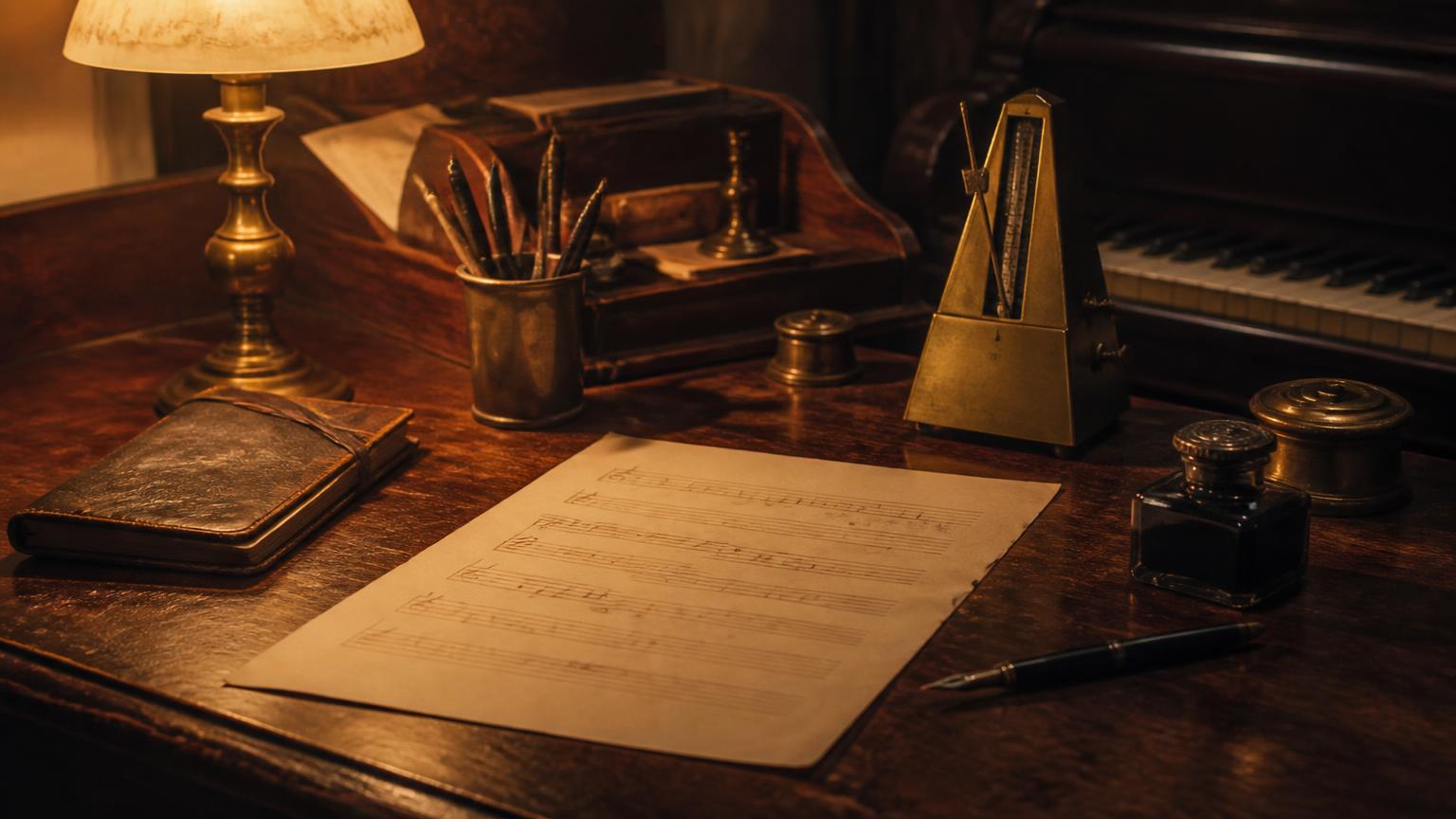
The rule
“No composing on a screen until the idea exists on paper.”
Technology still has a place. Engrave the score in notation software later, record it digitally, share it. But the first draft belongs on paper.
The desk
A ritual borrowed from the nineteenth century.
Nobody can recreate another composer's life or genius. What can be borrowed is the practice around it.
A wooden writing desk
One surface, kept for this and nothing else.
Good manuscript paper
Heavy enough that ink doesn't bleed through.
A fountain or dip pen
A quill is beautiful, but far harder to use every day.
Bottled ink
Refilling is part of the ritual, not an inconvenience.
A metronome
Mechanical. It doesn't notify you about anything.
A piano
The idea has to be played before it is written.
A notebook for musical ideas
Fragments, not finished thoughts.
No phone in the room
The single hardest item on the list.
Every evening
Play
Fifteen to twenty minutes. No goal beyond playing.
Write one idea by hand
A single musical idea, whatever state it is in.
Develop a few bars
On manuscript paper. Wrong notes stay on the page.
Record the intention
A note about what you were trying to express.
What that gives you
- A dated record of how a piece actually developed.
- Evidence of the wrong turns, which notation software quietly deletes.
- A first draft that cannot be undone with a keystroke.
- Something to read back in ten years that is not a file format.
First page
Polonaise No. 1
Date ____ / ____ / ________
The first page is written in ink at the top of the sheet.
Then the date.
Eight bars is enough for a first page.
Over time the score becomes the story of how the piece grew — not a blank notation window filled with typed notes.
Open questions
- Does writing by hand change which ideas survive the first evening?
- Is the slower pace useful, or simply slower?
- What is lost when the undo key exists?
- Does a dated manuscript help a composer more than a recording does?
“Even if the first page only holds eight bars, it is still the first page.”
Bring us a first page