
Question #261

Could every tree have a digital passport?

NOPACK RESEARCH · QUESTION

The Last Tube

Can toothpaste reach the mouth without leaving behind a disposable plastic tube?

Toothpaste is used for a few minutes each day.

Its container can remain as waste for far longer.

The Last Tube investigates whether oral care could be delivered hygienically and conveniently without requiring a new disposable plastic tube every time.

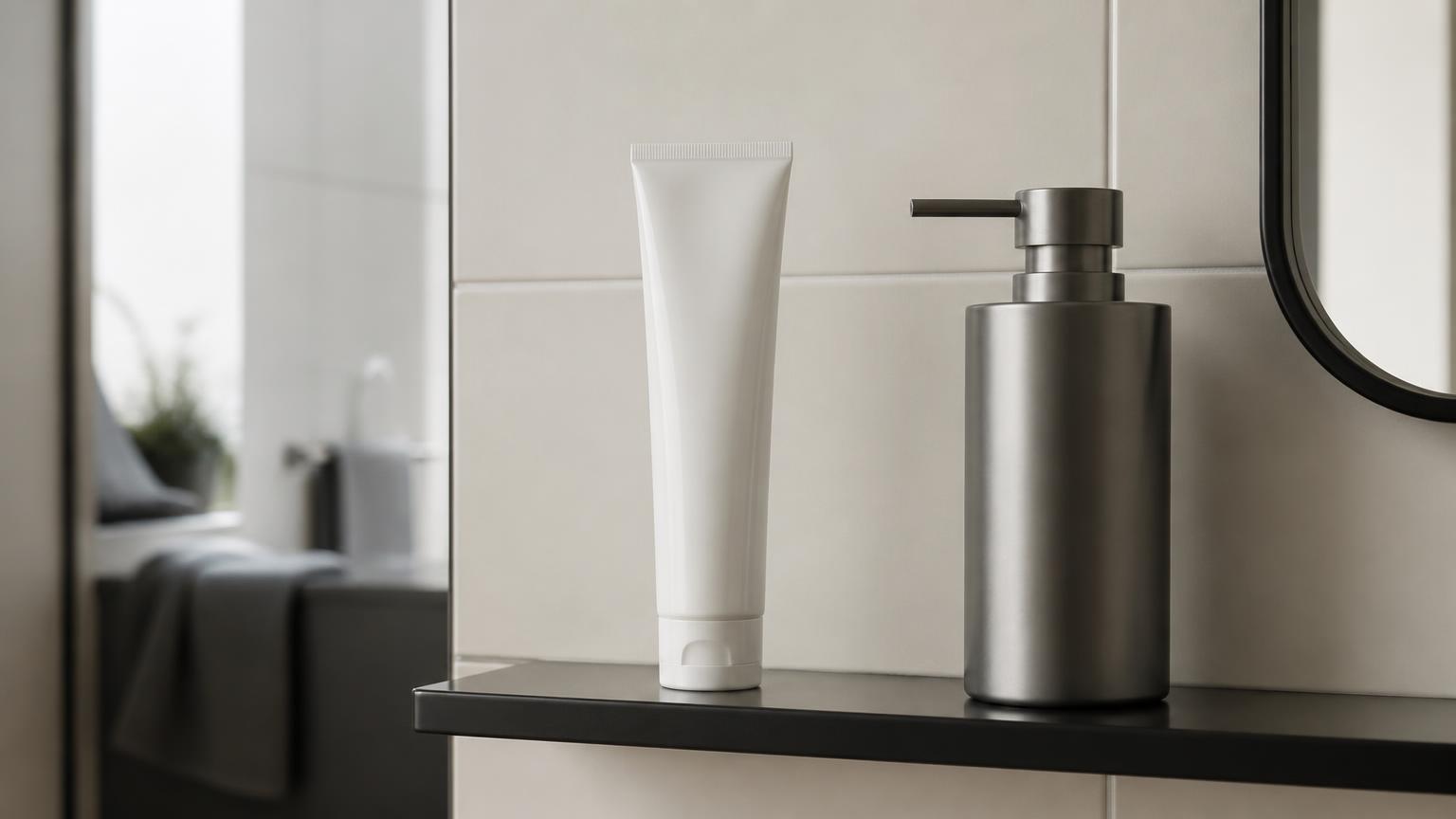
A plain unbranded toothpaste tube standing beside a permanent metal dispenser on a bathroom shelf
The last disposable tube? · Concept image. No product has been engineered or tested.

The observation

A permanent routine built around a temporary container.

Toothpaste must remain hygienic, stable, protected and easy to dispense. The familiar tube performs these jobs effectively, but it is normally discarded when the paste is finished.

Replacing plastic with paper may appear simple. In a wet bathroom environment, however, paper may require moisture barriers, liners, adhesives or coatings that introduce new recycling difficulties.

The problem may not be the material alone.

It may be the disposable container model.

What if we stopped redesigning the tube and made it unnecessary?

What we currently know

  1. 01

    Toothpaste requires protection

    A dispensing system must protect its contents from contamination, moisture, air and unintended access.

  2. 02

    Bathrooms are difficult environments

    Packaging and dispensers are repeatedly exposed to wet hands, humidity and changing temperatures.

  3. 03

    Paper is not automatically circular

    A paper appearance does not guarantee that a package can be recycled. Barriers, mixed materials and product residue may affect the available disposal route.

  4. 04

    Behaviour matters

    An environmentally preferable system will struggle if it is less hygienic, harder to use, inconvenient to refill or unpleasant in the mouth.

  5. 05

    The last portion matters

    Conventional tubes can retain product that is difficult to remove. A different delivery system could address both packaging and product waste.

The central concept

One dispenser. Many uses.

Early concept — not engineered or tested

  • A durable bathroom dispenser remains in the home.
  • Toothpaste is supplied through a substantially smaller replaceable cartridge.
  • The cartridge is designed to collapse as its contents are dispensed.
  • A measured action releases a consistent portion.
  • The external dispenser is designed to remain clean and easy to handle.
  • Used cartridges could enter a controlled return, cleaning and refill system.
  • Different oral-care formulations could potentially use a common interface.

The ambition is not to pretend that no material is required. It is to determine how little temporary material is genuinely necessary.

Proposed loop — not validated

  1. MAKE

    Toothpaste is prepared and filled under controlled conditions.

  2. USE

    A durable dispenser provides a measured portion.

  3. RETURN

    The closed cartridge is collected through an appropriate return route.

  4. CLEAN

    Components are inspected and processed through a validated system.

  5. REFILL

    Suitable cartridges return to circulation.

This loop is a proposal. It is not currently hygienically validated, economically viable or demonstrated to be environmentally superior.

Three research directions

01

The Returnable Cartridge

A collapsible cartridge designed for a controlled reuse loop.

Speculative research direction

  • Which components could safely be reused?
  • How would returned units be inspected and cleaned?
  • How much material would remain necessary?
  • Could the return journey outweigh the material benefit?
  • Who would operate the loop?

02

The Dry Ribbon

A reel of individually measured, fast-dissolving oral-care portions inside a reusable dispenser.

Speculative research direction

  • Can each portion deliver a consistent formulation?
  • How would the reel remain protected from bathroom humidity?
  • Could portions be separated without contaminating the remainder?
  • Would the experience feel natural to use?
  • What safety testing and regulatory assessment would be required?

03

The Soft Portion

A soft, rapidly dissolving toothpaste portion intended to feel closer to paste than a conventional hard tablet.

Speculative research direction

  • Could it remain stable during transport and storage?
  • How would portions avoid sticking together?
  • Could it be protected with minimal temporary material?
  • Would it work for children and people with different access needs?
  • Would users prefer it to conventional toothpaste tablets?

Why not simply make the tube from cardboard?

Cardboard is useful, familiar and widely understood, but toothpaste presents several challenges:

  • Moisture.
  • Product residue.
  • Barrier protection.
  • Repeated squeezing and folding.
  • Seals and closures.
  • Mixed-material linings.
  • Bathroom durability.

A cardboard outer structure may form part of a future solution, but it should not be presented as recyclable until the entire material construction and relevant local recycling route are known.

Brown packaging is not evidence of circular packaging.

What must be proven

  • Product stability.

    Not yet tested by Quinn Labs

  • Hygiene throughout repeated use.

    Not yet tested by Quinn Labs

  • Contamination prevention.

    Not yet tested by Quinn Labs

  • Consistent portioning.

    Not yet tested by Quinn Labs

  • Child-resistant considerations where appropriate.

    Not yet tested by Quinn Labs

  • Accessibility and grip.

    Not yet tested by Quinn Labs

  • Cleaning method.

    Not yet tested by Quinn Labs

  • Cartridge durability.

    Not yet tested by Quinn Labs

  • Return participation.

    Not yet tested by Quinn Labs

  • Transport efficiency.

    Not yet tested by Quinn Labs

  • Full lifecycle impact.

    Not yet tested by Quinn Labs

  • Real recycling or reuse route.

    Not yet tested by Quinn Labs

  • Regulatory and dental-professional assessment.

    Not yet tested by Quinn Labs

  • Consumer acceptance.

    Not yet tested by Quinn Labs

  • Commercial cost.

    Not yet tested by Quinn Labs

Could the important invention be the connection?

If every manufacturer created a different proprietary dispenser, households could accumulate more permanent objects rather than fewer.

The Last Tube therefore asks whether the useful outcome might be an open or licensed interface that allows compatible oral-care refills to work with a common durable dispenser.

  • Cartridge dimensions.
  • Mechanical connection.
  • Tamper evidence.
  • Product identification.
  • Measured dispensing.
  • Cleaning boundaries.
  • Material identification.
  • End-of-life responsibility.

Standards concept — no specification has been developed

Accessibility

A better environmental system must also be easier to use.

  • One-handed operation.
  • Low grip strength.
  • Visual impairment.
  • Measured dispensing.
  • Clear indication when nearly empty.
  • Easy cleaning.
  • Different household users.
  • Travel use.
  • Avoiding confusion between formulations.

NoPack is not necessarily no container.

NoPack investigates whether products can move and be used without creating disposable packaging at every transaction.

For toothpaste, a completely unpackaged product may not be safe or practical. The more useful challenge may be to distinguish permanent protection from temporary waste.

Explore NoPack Research

Grand Challenge 001 · NoPack

Can products move safely and reach people without disposable packaging?

The Last Tube is one research question inside this larger challenge.

Research response prototype

What would make you stop buying toothpaste tubes?

Nothing is submitted or published. Your selections stay in this browser tab.

This question cannot be solved by packaging design alone.

  • Oral-care manufacturers.
  • Dentists and dental researchers.
  • Packaging engineers.
  • Materials researchers.
  • Hygiene and microbiology specialists.
  • Reuse-system operators.
  • Retailers.
  • Accessibility specialists.
  • Lifecycle-assessment researchers.
  • Regulators and standards organisations.
Explore a research collaboration

The familiar toothpaste tube solved a difficult dispensing problem.

The next question is whether we must keep throwing the solution away.

Quinn Labs · Building tomorrow’s obvious ideas.