
Question #260

Can buildings explain how they use energy?

← Work

Project Evolution · Speculative Research

What if evolution never stopped?

Project Evolution uses real evolutionary principles to imagine how life might continue to adapt over millions of years. Speculative, clearly labelled, and always explained.

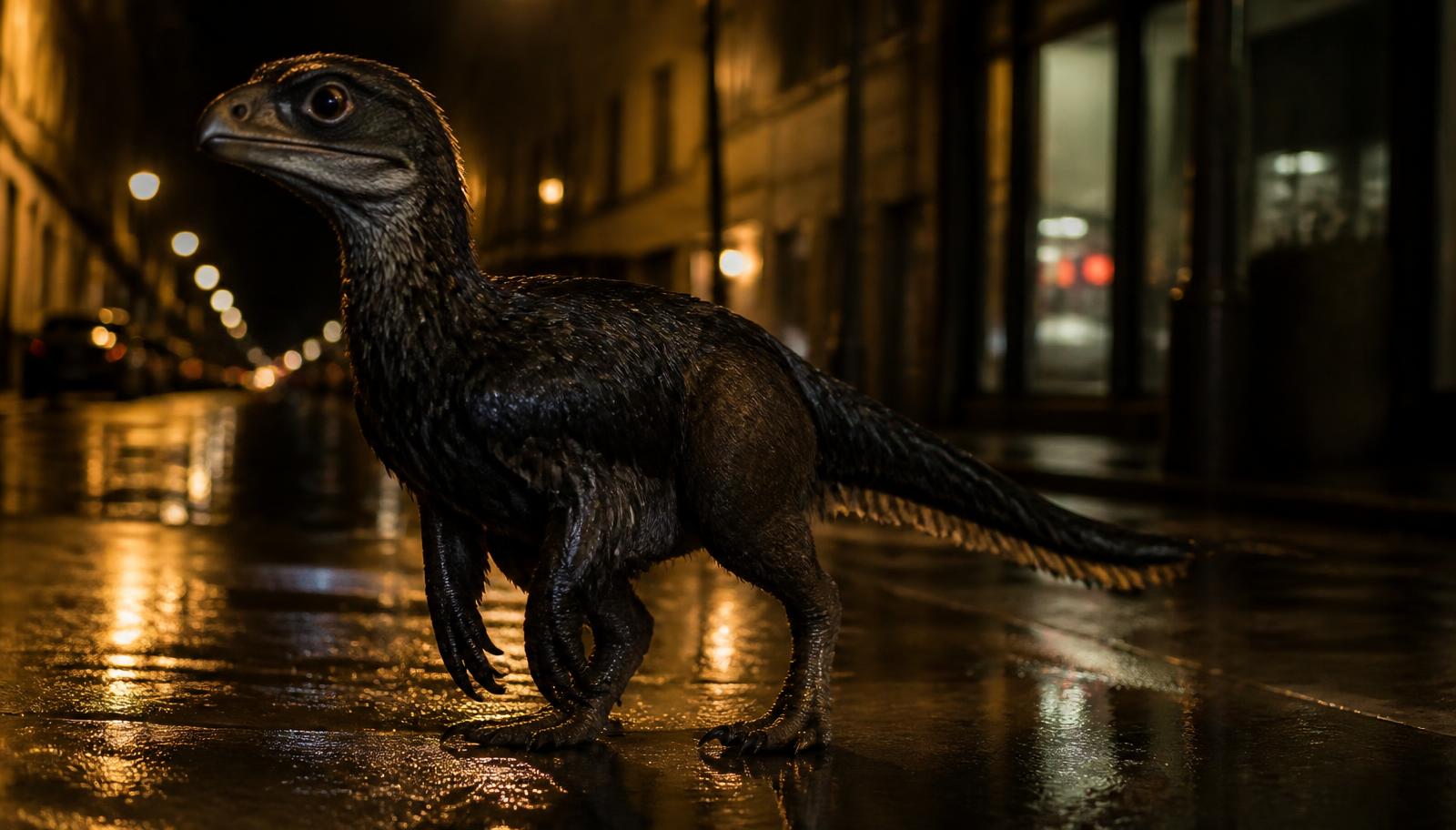
Concept image of a fox-sized feathered raptor standing on a wet city street at night under sodium lighting
Concept image. The Urban Raptor — invented animal, real evolutionary reasoning.

What if evolution never stopped?

Research

The question

How might life continue to adapt over millions of years?

If dinosaurs had survived, how might they have adapted over millions of years?

If dinosaurs had survived, how might they have adapted? Not a fantasy question. Cities, climate, competition and food supply all apply the same pressures they apply to every living species today.

Every creature in this project is invented. Every reason behind it is not. Each design starts from a real ancestor, a real habitat and a real selection pressure, then follows the reasoning forward.

Scientifically inspired speculative concepts. Not predictions, and not claims of scientific fact.

How each creature is designed

  1. 01AncestorStart from a real species with real anatomy.
  2. 02PressureChoose a real force: climate, food, predators, humans, space.
  3. 03Trade-offEvery gain costs something. Bigger eyes, weaker daylight vision.
  4. 04AdaptationFollow the pressure forward across millions of years.
  5. 05Label itSeparate what is grounded in evidence from what is invented.

Speculative species

Invented animals. Real reasoning. Each one states what is grounded and what is imagined.

Urban Raptor

Smaller than its historical relatives. Built for the city at night.

Size
Fox-sized. Roughly 60cm at the shoulder, 8–10kg.
Habitat
Cities, railway margins, industrial estates, drainage corridors.
Diet
Omnivorous. Refuse, rodents, insects, fruit, whatever the week provides.
Behaviour
Nocturnal, wary of people, works alone or in pairs, memorises bin collection days.
Inspired by
Velociraptor and other small dromaeosaurs.

Grounded in evolutionary evidence

  • Island and urban dwarfism: limited territory and food favours smaller bodies.
  • Nocturnality reduces conflict with humans, as it has for urban foxes.
  • Generalist omnivory is the single strongest predictor of urban survival.
  • Enlarged eyes and a wider retina follow directly from low-light foraging.

Imagined

  • That any dromaeosaur lineage would have survived at all.
  • The specific body size and plumage colouring.
  • The degree of tolerance towards people.

Marsh Titan

A long-legged wader of shallow water and slow rivers.

Size
Nine metres long. Legs built for depth, not speed.
Habitat
Wetlands, estuaries, flooded plains, reed beds.
Diet
Aquatic plants, reeds, algae mats, submerged roots.
Behaviour
Slow, herd-living, non-territorial, migrates with seasonal flooding.
Inspired by
Diplodocid sauropods.

Grounded in evolutionary evidence

  • Wetlands are stable, plant-rich habitats that reward large slow herbivores.
  • Long limbs are a repeated answer to wading; herons and moose arrived there separately.
  • Herd behaviour reduces predation risk in open ground.
  • Water buoyancy relieves load on very large bodies.

Imagined

  • That sauropod gigantism would persist in a colder, drier modern world.
  • The switch to a mostly aquatic plant diet.
  • Seasonal migration routes.

Forest Glider

Feathers repurposed for controlled descent, not powered flight.

Size
Cat-sized. Two-metre span with arms and tail feathers extended.
Habitat
Dense temperate and tropical woodland, high canopy.
Diet
Insects, eggs, seeds, small vertebrates.
Behaviour
Arboreal, glides between trunks to hunt and to escape ground predators.
Inspired by
Microraptor and other four-winged feathered dinosaurs.

Grounded in evolutionary evidence

  • Gliding has evolved independently in squirrels, lizards, frogs and snakes.
  • Microraptor already had flight feathers on all four limbs.
  • Canopy life rewards travel that costs less energy than climbing down and up.
  • A long tail is an effective aerial rudder.

Imagined

  • That gliding stayed gliding rather than becoming powered flight.
  • The exact wing loading and feather arrangement.
  • The insect-heavy diet.

Beyond dinosaurs

Future birds

What happens to flight in a world of towers, turbines and warmer winters?

Future insects

Generation times measured in weeks. Adaptation visible within a human lifetime.

Future trees

Slower than anything else here, and the most affected by a shifting climate.

Future ocean life

Warmer, more acidic, quieter in some places and far louder in others.

For children

The New Dinosaurs

A comic and learning series for children. Each edition introduces one invented creature and explains exactly why it turned out that way.

What children learn

EvolutionAdaptationClimateHabitatsFood chainsNatural selection

Possible formats

BooksComicsClassroom resourcesAn appTrading cardsAR species discovery

Children are not told the answer. They are asked why this animal would evolve that way.

Why this is defensible

The moat is not drawing interesting dinosaurs.

It is building a world where every creature is explained through evolutionary reasoning.

Creativity carries the story. Science carries the answer.

Research card

Prototype ResearchEducation • Speculative biology • Publishing

Can speculation teach science better than instruction?

Talk to Quinn Labs

Research question

How might life continue to adapt over millions of years?

Why this matters

Children are taught evolution as a finished story about the past. It is a live process, and speculation is one of the few ways to make that obvious without turning it into a lesson.

Current progress

Prototype research — species reasoning framework drafted, first three creatures written, children’s series in concept.

Workflow

Research

Real selection pressures, real ancestors, and a strict line between evidence and imagination.

How it could work

Problem

Evolution is taught as history, so it feels finished.

Current world

Fantasy creatures with no reasoning, or textbooks with no imagination.

Quinn Labs idea

Invent the animal, then explain exactly why it would turn out that way.

Potential future

Children who ask why an animal evolved that way before they ask what it is called.

Pick a real ancestorPick a real pressureFollow the trade-offsDraw the animalLabel grounded versus imagined

Research board

Note

Honesty rule

Every creature separates what is grounded in evolutionary evidence from what is invented. No exceptions.

Reading

Convergent evolution

Gliding appeared independently in squirrels, lizards, frogs and snakes. Good grounding for the Forest Glider.

Sketch

Urban Raptor

Fox-sized, nocturnal, omnivorous. Urban survival favours generalists, every time.

Open questions

  • Broader framing

    Not what dinosaurs would look like today. What if evolution never stopped — birds, insects, trees, oceans.

See the bench in the Workshop

Future possibilities

Research directions only. None of these exist, and some never will.

Comic and book seriesClassroom resourcesTrading cardsAR species discoveryFuture birds and insectsFuture ocean life

Questions we're asking

  • Why would this animal evolve that way?
  • What pressure produced it?
  • What did it trade away?
  • Which parts are real reasoning?

Potential collaborators

PalaeontologistsEvolutionary biologistsTeachersIllustratorsChildren’s publishers

We prototype possibilities. Not every question has an answer. Every answer begins with a question.