
Project Root
Can soil tell its own story?
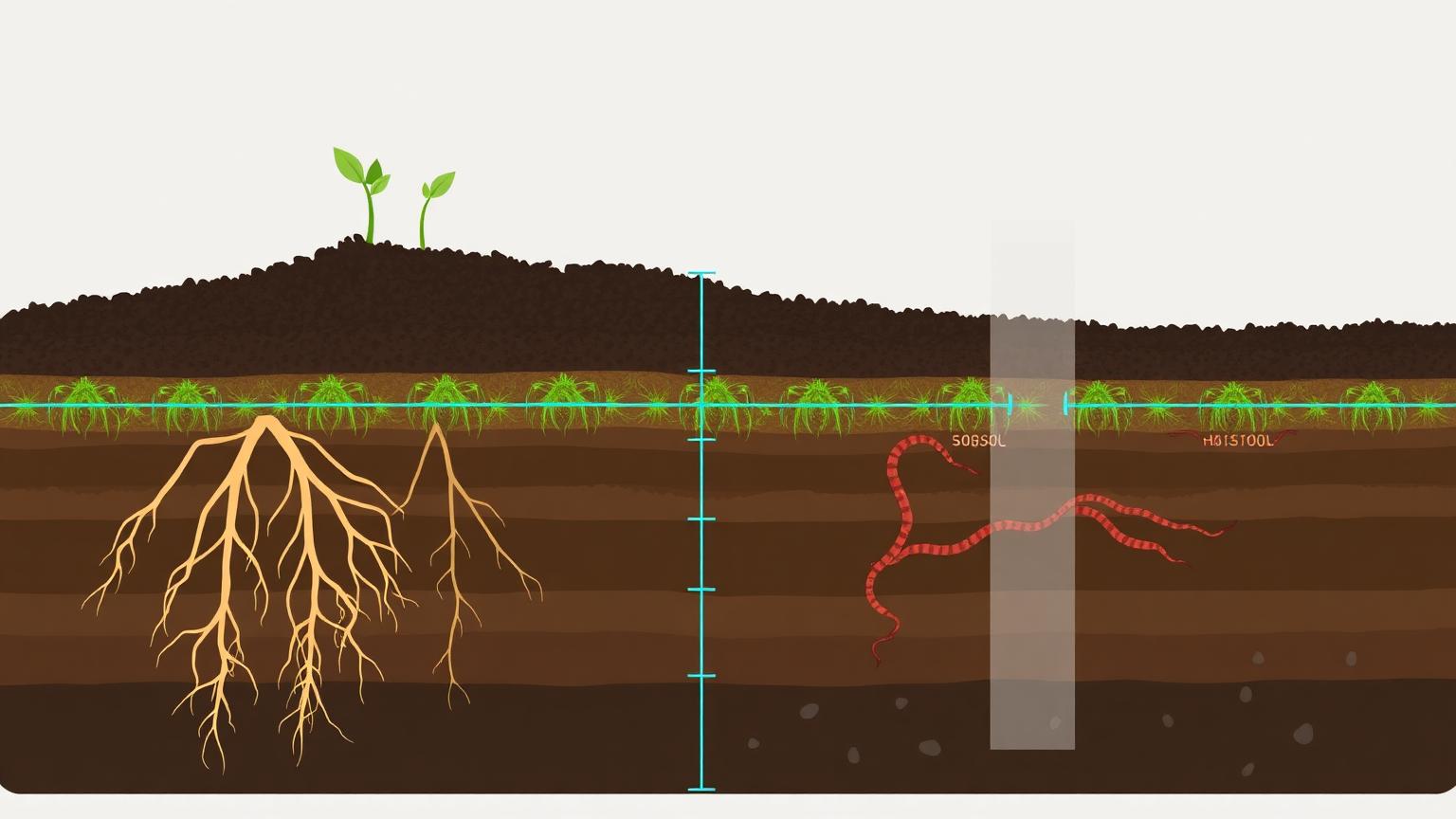
Turn soil from an invisible asset into something a grower, a council or a buyer can actually read.
ResearchThe problem
Soil is the largest thing a farm owns and the least measured. It is tested rarely, described in numbers few people can interpret, and degraded slowly enough that nobody notices in a single season.
What we built
Turn soil from an invisible asset into something a grower, a council or a buyer can actually read.
Where it is now
Research — deciding what belongs in a score that a farmer would trust and a buyer would accept.
Research questions
- Can soil tell its own story?
Future concepts
Research only. These are not existing features.
Who it's for
Components
Research question
“Can soil tell its own story?”
Why this matters
Soil is the largest thing a farm owns and the least measured. It is tested rarely, described in numbers few people can interpret, and degraded slowly enough that nobody notices in a single season.
Current progress
Research — deciding what belongs in a score that a farmer would trust and a buyer would accept.
Workflow
Research
Researching: soil health scoring, carbon, organic matter, nutrients, compaction, biodiversity.
How it could work
Problem
Nobody can see what is happening underground until yield falls.
Current world
An occasional lab test read by an agronomist and filed away.
Quinn Labs idea
A repeatable score that shows direction of travel, in language a non-specialist can use.
Potential future
Soil condition treated as an asset on the balance sheet, and priced as one.
Research board
Slow signal
Soil change is measured in years. Any product built on it must survive being boring.
Compaction
Often the biggest yield constraint and almost never measured, because the machine that causes it is also the one collecting the data.
Open questions
One number?
A single score is usable and lossy. Does it help, or does it hide the thing that matters?
Future possibilities
Research directions only. None of these exist, and some never will.
Questions we're asking
- Can soil tell its own story?
- A soil health score built from carbon, structure and life, not nutrients alone
- Low-cost repeat sampling instead of a lab test every five years
- Compaction mapping from machinery data already being collected
Potential collaborators
Related projects
Question
Project Rain
Treat rain falling on a building as a resource with a second use, not a drainage problem.
Question
Project Seed
Match varieties to the climate a place is heading for, not the one it had.
Question
Project Bloom
Make it obvious what to plant, and when, so ordinary gardens add up to a corridor.
Research
Project Canopy
Put the next tree where it does the most work — for heat, for flooding and for air.
Pilot
One Fleet
Decision intelligence for commercial fleets.
We prototype possibilities. Not every question has an answer. Every answer begins with a question.
Similar problem in your business?
Tell us what you're trying to solve. We'll say whether it's worth building.
Start a project